
A Day in Practice at Little Minds
Updated: Feb 3
A day at Little Minds Early Years is not defined by ticking boxes or simply getting through the timetable. It is shaped by relationships, observation, and responsiveness. Much of my time is spent supporting practice, being present on the floor, modelling interactions, observing children, and helping staff reflect on their own approaches.
Leadership in early years is often misunderstood. It is not just about policies, rotas, or compliance. It is noticing when a practitioner needs support before they ask. It is about protecting children’s emotional wellbeing in the middle of a busy day. It is balancing the realities of ratios, paperwork, and expectations with the values that brought us into this profession in the first place.
Some of the most important moments in the day are the quiet ones. These include a practitioner gaining confidence, a child feeling safe enough to take a risk, or a conversation that prompts reflection rather than instruction. These moments remind us why we do what we do.
The Importance of Relationships
Building strong relationships is at the heart of early years practice. When we connect with children and staff, we create an environment where everyone feels valued. This sense of belonging is crucial for emotional development. I strive to foster an atmosphere where children can express themselves freely and staff can share their thoughts and ideas without fear of judgement.
In my experience, the best learning happens in a supportive environment. When practitioners feel confident, they can take risks in their practice. This leads to innovative approaches that benefit the children in our care. I often remind my team that we are all learners in this journey together.
Leadership Beyond the Title
For a long time, progression in early years has been framed as moving “up” from practitioner to room leader, and from room leader to manager. While leadership roles are vital, I have come to question the idea that growth only happens in one direction. Being a manager does not automatically make practice stronger, just as stepping out of management does not mean stepping away from leadership. True leadership is rooted in practice, presence, and a willingness to keep learning.
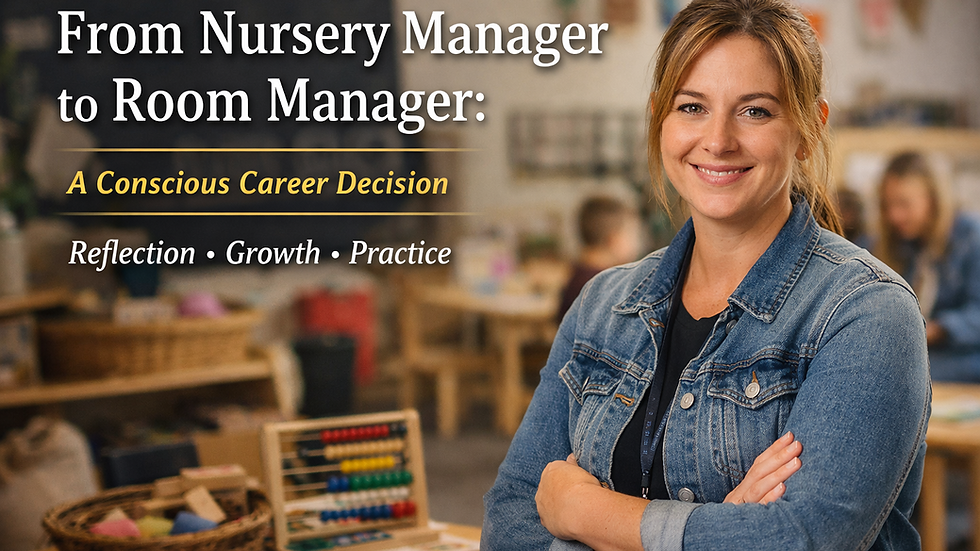
This reflection has led me to make a conscious career decision.
Why I’m Stepping Back to Move Forward
I am stepping out of my nursery manager role and into a room manager position within a large chain nursery. This decision was not made lightly, nor was it driven by circumstance. It was a deliberate choice to strengthen my practice and broaden my professional understanding.
Working within a larger organisation offers opportunities to experience early years provision at scale. I want to understand systems, consistency, and leadership structures in a different context. I aim to learn from this environment, to reflect critically on what works, what challenges arise, and how high-quality practice can be maintained within larger frameworks.
I believe that to lead well and to support others effectively, we must remain practitioners first. Stepping back into a room-based leadership role allows me to reconnect deeply with day-to-day practice while continuing to grow as a reflective professional.
What I Hope to Learn
This next chapter is about development, not status. I am particularly interested in exploring:
How consistent practice is maintained across large teams
How leadership is developed and supported within structured systems
How staff wellbeing is balanced alongside expectations
How values-led practice can exist within organisational frameworks
My core beliefs have not changed. Children’s emotional wellbeing, respectful interactions, and reflective practice remain central to everything I do. I am excited about the journey ahead and the insights I will gain.
A Reflection for Others
If you are an early years professional questioning your own pathway, I want to offer this reassurance: progression does not always mean moving upwards. Sometimes growth comes from stepping sideways or even back with intention and clarity. Titles do not define our impact. Practice does.
I hope to continue sharing reflections from this next stage of my journey and to contribute to honest conversations about leadership, development, and sustainability within the early years sector.
I believe that by embracing change and being open to new experiences, we can all enhance our practice. The journey is as important as the destination, and I look forward to discovering what lies ahead.


Comments